For the last month every plot in this studio has run on one machine, the UUNA
TEK ArtStation 2436. It is a 36 by 24 inch CoreXY pen plotter, and it replaced
my A3 machine as the daily driver the week it arrived. This review follows six
plots that took it from a first squareness check to the seed of a new series.
Full disclosure first: this machine and this review are part of a UUNA TEK
content partnership. They have had no say in the contents of this review, and
the opinions expressed here are my own.
Some context for reading it. This is a data art studio, and pen plotting is
the medium: the machines are not a novelty here, they are how the work gets
made. So I do not evaluate a plotter on flashy features. I ask four
things of a machine: precision, the same behavior every day, repairs I can
do myself, and a fit with the tools and habits I have already standardized
on. That is the lens for everything below.
The machine
The working area is 36 by 24 inches (915 by 610 millimeters), which covers an
A1 sheet with the margins intact. The frame is a closed rectangle of
extruded aluminum with the gantry supported on both sides. The bed is a
magnetic steel plate: sheets are held flat with loose magnets, which is faster
than tape and leaves nothing on the corners of the paper.
The motion system is CoreXY, and I like CoreXY plotters. Both stepper motors
stay fixed at the frame's top corners and a single crossed belt moves the
carriage, so almost nothing heavy travels: the motion is smooth, the design
scales well in size, and the footprint stays fixed. Cantilevered plotters
photograph well and look nice on a desk, but the unsupported arm can wobble
and sag, and maintenance on them can be tough. I come from laboratory
automation, and good old extruded aluminum rails work just fine for me. My
iDraw H SE is the same closed-frame CoreXY layout at A3, so this is the
geometry I am coming from; the 2436 scales it up rather than replacing it.
Three numbers from the spec sheet matter, translated into pen terms. Minimum
motion resolution is 0.0125 millimeters, about one twenty-fourth of the line
a fine fountain-pen nib leaves. Stated repeatability is plus or minus 0.05
millimeters at low speeds, one sixth of that same 0.3 millimeter line.
Mechanical precision is 0.1 millimeters. Together they mean that if a line
lands visibly wrong on this machine, the cause is the pen, the paper, or my
file, not the positioning. A month of plotting bore that out.
The controller (DrawCore V1.3) runs EBB firmware over plain wired USB, the
same protocol family my existing toolchain already speaks, so the machine
slotted into my pipeline on day one with no new software. If you do not have
your own toolchain it runs from Inkscape; I never needed to open it. And the
whole thing works offline, with no account and nothing phoning home.
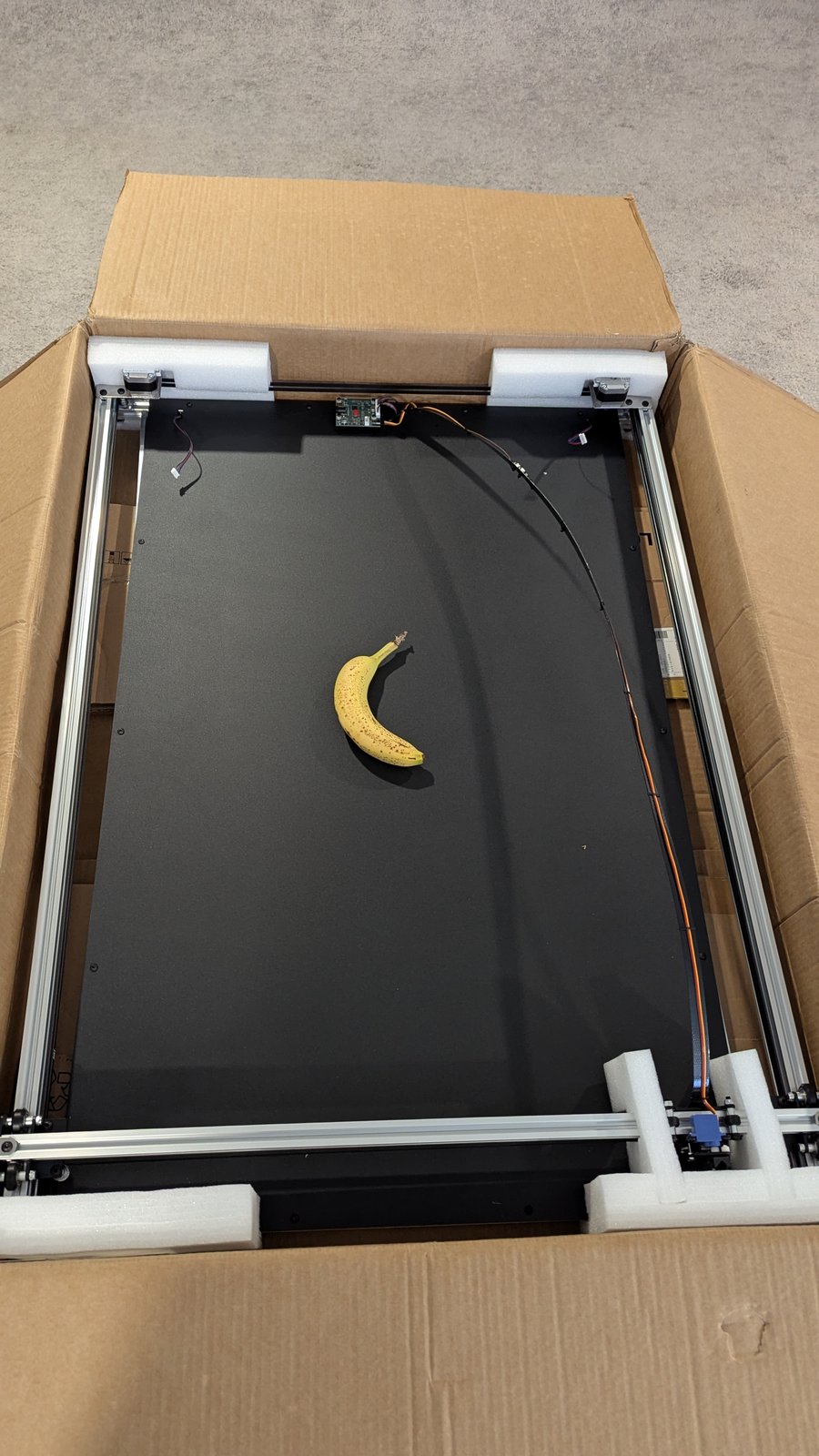
Shipping was a bit of a headache. I ordered the machine on July 15 and it
arrived by ocean freight on August 26, six weeks later. The box arrived with
a puncture, and the impact had knocked the frame out of square: the base had
racked into a parallelogram relative to the top rail the head runs on.
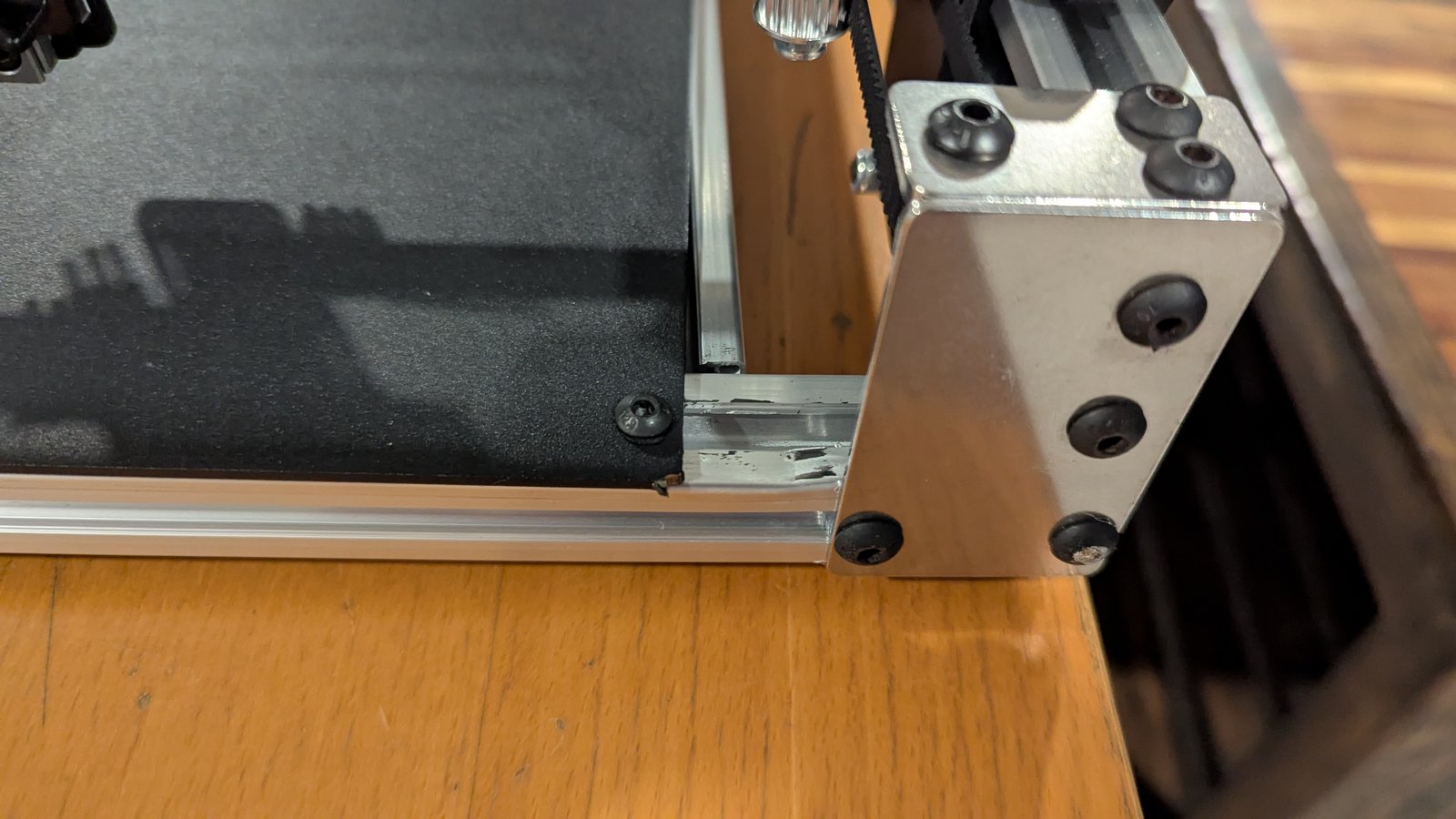
The fix turned out to be simple, and the design deserves credit for that. The
baseplate is detachable and adjustable, so the repair was: loosen the screws
holding the base to release the tension the shift had put into the frame,
realign the base against the top rail, check the diagonals until they match,
and retighten. Under fifteen minutes, and the frame has held square through
everything since, including the full-bed and stress-test plots below. UUNA
TEK's support answered my damage photos within a day with exactly those
steps, which is what I want from a vendor when freight goes badly.
Past that repair, setup was plugging in the stepper motor connectors and the
servo wiring. That is the whole assembly story: the machine ships essentially
built, and I was plotting the same day.
Where I am coming from
My previous daily driver is an iDraw H SE, an A3 machine on the same CoreXY
closed-frame layout. It is the machine this studio grew up on, and it taught
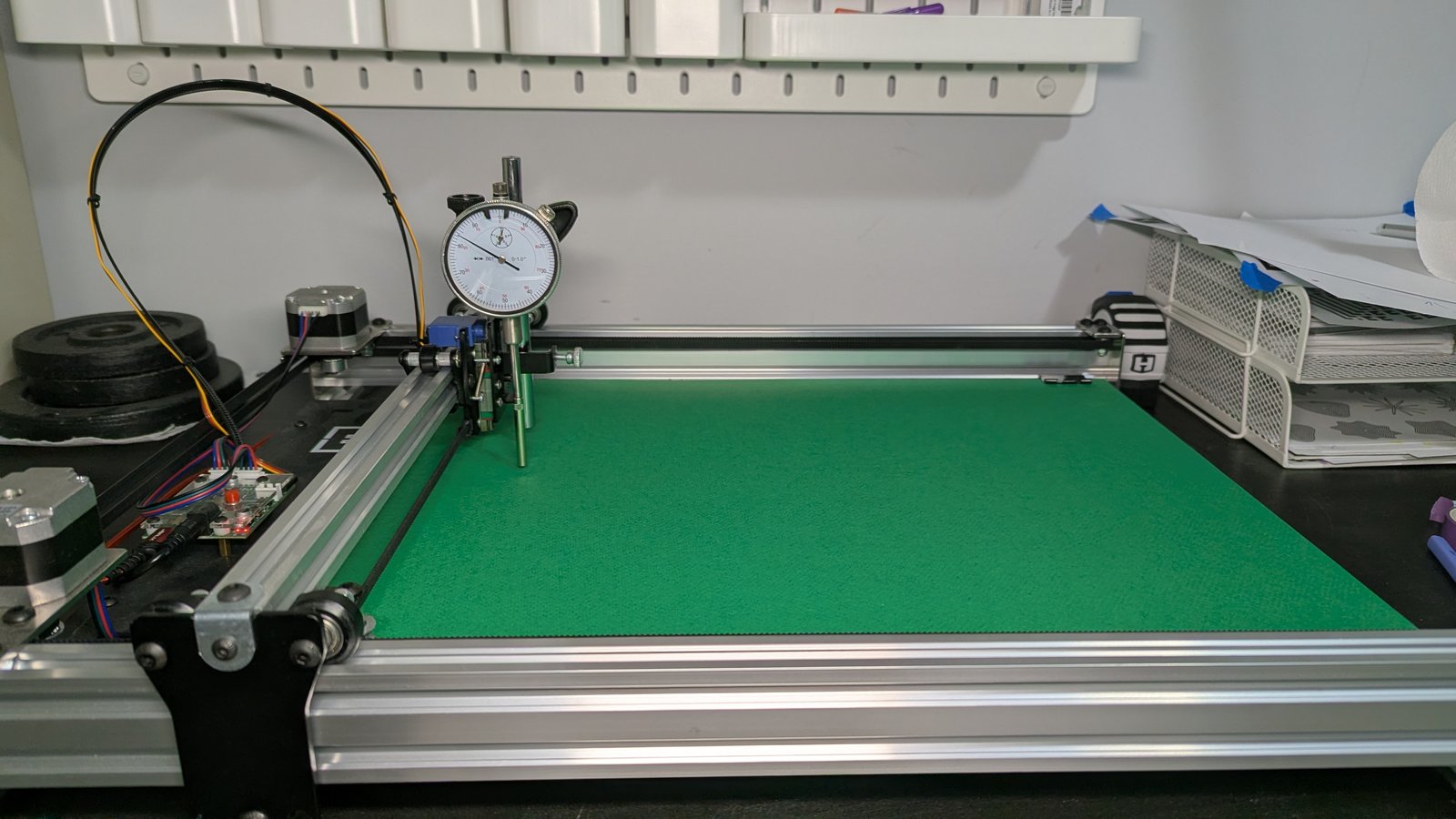
me exactly what to distrust in a plotter. Its bed developed a belly over
time. I found it with a dial indicator swept
across the plate and fixed it with shims, and since then I do not take a flat
bed on faith from anyone.
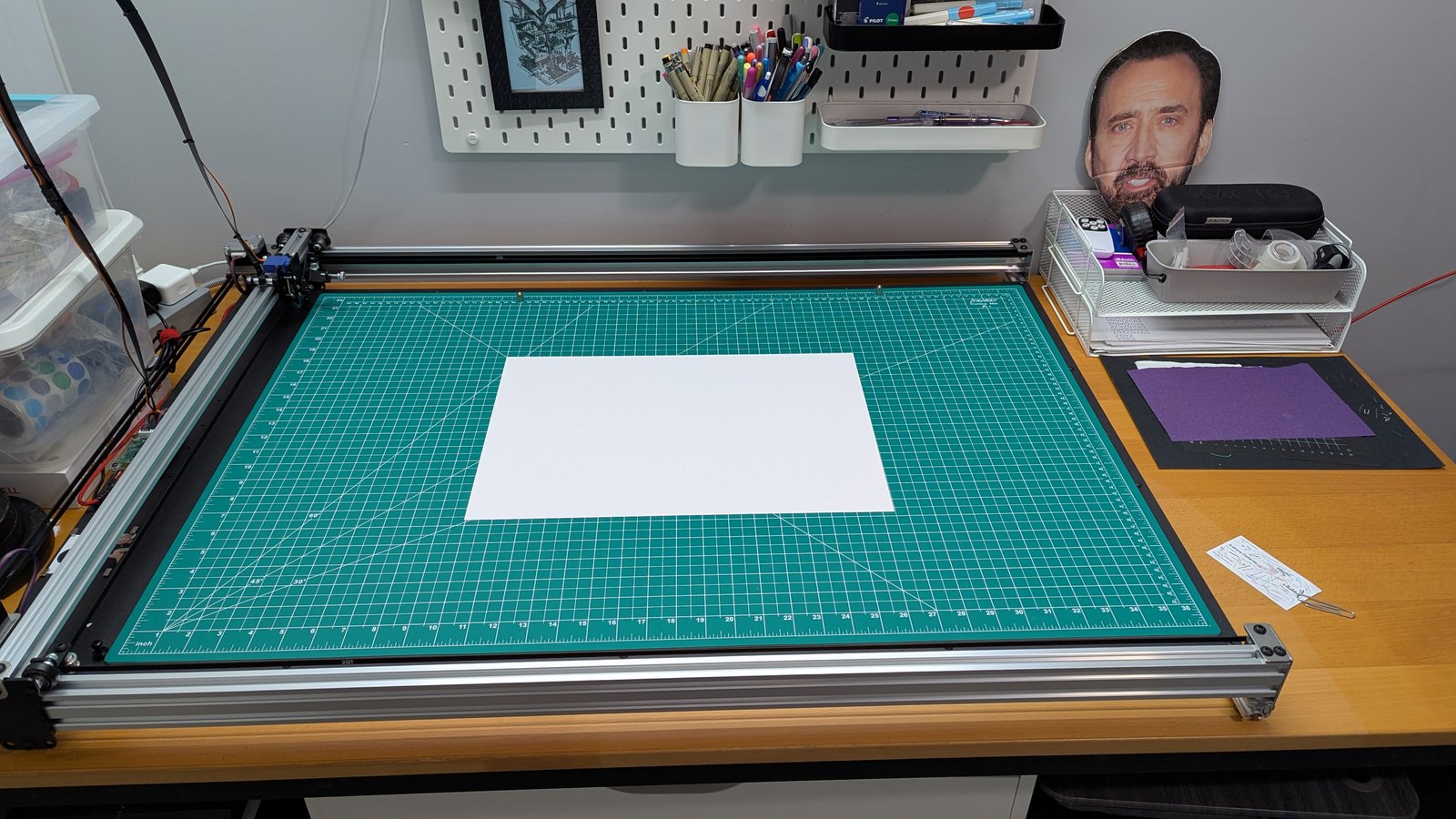
On paper the two machines are close relatives. The differences that matter
are size and rated speed; nearly everything else carries over. In the photo
above, the white A3 sheet is the entire print area the H SE could give me;
it sits on an A1 cutting mat, and the mat itself fits the ArtStation's bed
with room to spare. This plotter is huge.
iDraw H SE (A3)
ArtStation 2436
Working area
297 × 420 mm (A3)
610 × 915 mm (24 × 36 in)
Machine footprint
560 × 460 × 115 mm
1060 × 773 × 115 mm
Weight
6.1 kg
15 kg
Motion
CoreXY, closed frame
CoreXY, closed frame
Minimum motion resolution
0.0125 mm
0.0125 mm
Rated max speed
200 mm/s
280 mm/s
Controller
EBB firmware, wired USB
EBB firmware, wired USB
Bed
developed a belly, shimmed flat by me
magnetic steel plate, flat as delivered
The H SE also set my registration baseline. I have run as many as 18 layers
on a single A3 sheet on that machine, so I know what good layer-to-layer
registration looks like at small format and what it costs in care. The
question this month was whether a bed four and a half times larger keeps that
behavior. The six plots below are the acceptance tests, in order, each chosen
to answer one thing.
Headroom
Before the tests, the thing that changed my day-to-day most. Plotting A3 on
an A3 machine means working at the machine's limit all the time. There is no
margin for error in placement, and the head and rail always need adjusting to
clear whatever is on the stage. Registration in that regime is an exercise in
squeezing: lining a new pen up as far up and over as the machine allows,
because the piece already occupies everything the machine has.
A3 and the imperial sizes just beyond it are the bread and butter of my
catalog, and on a 36 by 24 bed they sit in the middle of the plate with room
on every side. I have room to align and move things around, and I stage the
next layers' pens on the deck itself while a layer runs (which I do
constantly and do not recommend). Registration gets fundamentally simpler when
the print is nowhere near the envelope. It shows up most clearly in mixing pen
types: fountain pens, 3 millimeter acrylic markers, and fineliners all sit at
different resting heights and positions in the clamp, and on the old machine a
swap at the edge of the envelope could push the new pen past what the machine
could reach. On the 2436 I can run all three in one A3 piece without losing
registration. That headroom is the most liberating thing about this plotter,
more than the maximum sheet size itself.
The torus, wall to wall
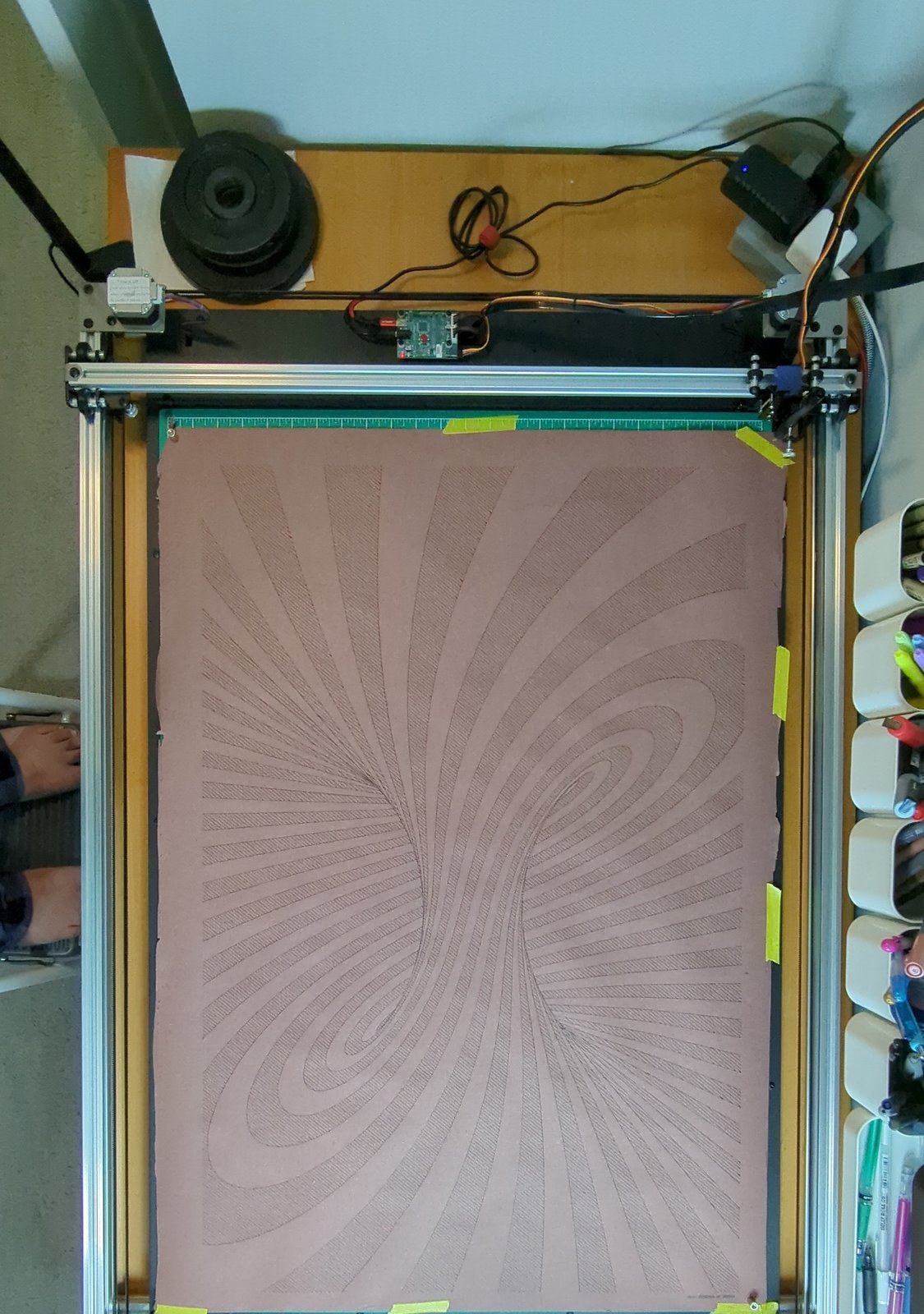
The first plot was deliberately simple and deliberately huge: a torus I
rendered from Turtletoy, drawn as a single layer with hatching, with a
standard 0.7 millimeter gel ballpoint, on a full 36 by 24 sheet.
With one pen and one layer, any problem shows. I wanted to know whether the
frame was still square after my adjustment, whether the rails were aligned,
and whether the carriage could reach and draw cleanly everywhere on the
sheet. A skipped line, visible ringing on the long sweeps, or hatching that
drifts would have set this review on a different course.
None of that happened. The hatching is even across the full width, I found no
skipped lines, and the curves show no ringing I can see. A gel ballpoint at
0.7 millimeters is the most forgiving tool I own, so this was the machine's
easiest test, and it passed without a caveat. The full plot, start to finish,
is on Instagram.
Freddie at 80
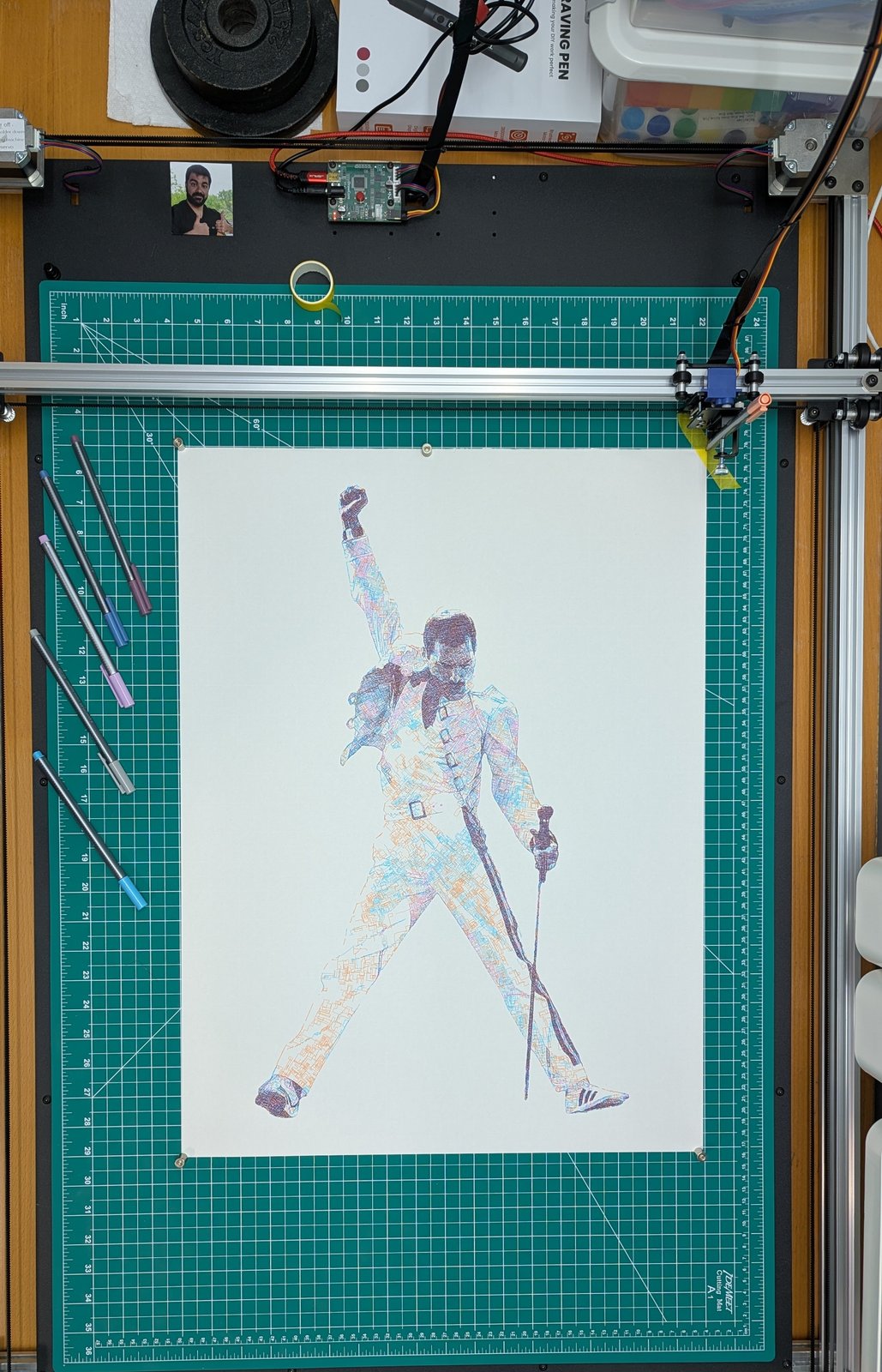
Next, color registration. For what would have been Freddie Mercury's 80th
birthday I plotted an 18 by 24 portrait in six layers, one pen per layer:
Staedtler fineliners on lightweight Strathmore drawing paper. The fineliners
are my staple for multi-color work. They are reliable, they bleed very little,
the tips hold up over hours, and on this paper they glide. They are less
lightfast than I would like, which I accept for test pieces.
I was worried about the dense passages, the hair and the microphone, where
six layers of marks pile up. They came out clean. End to end the piece
took five hours at relaxed speeds, and the print matched the render. The
plot video is on Instagram.
The bird study
The third test inverted the scale question. Most of my catalog needs density
and precision more than it needs size, and some of my early pieces used every
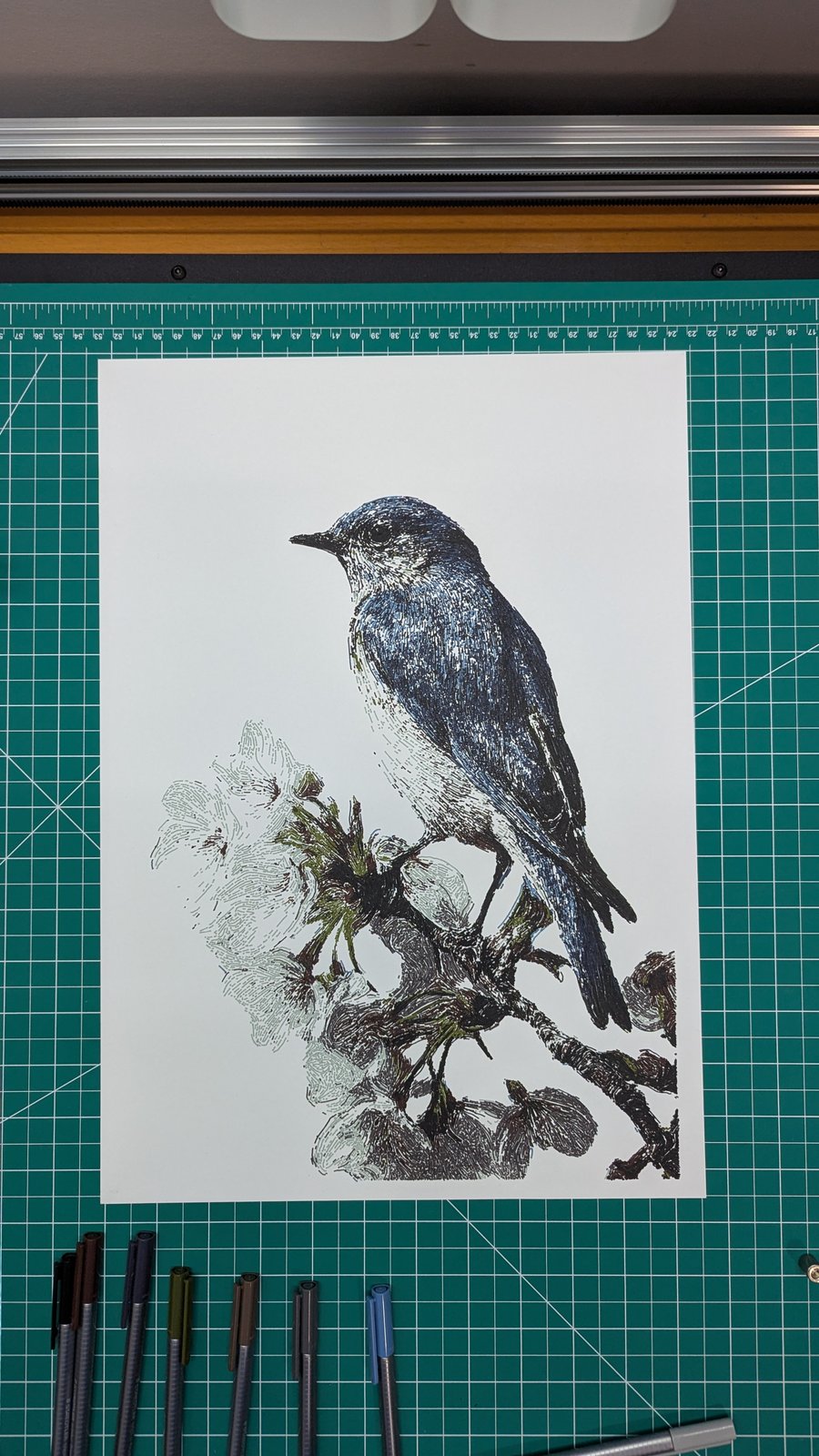
millimeter the A3 machine had. So I plotted an A3 bird study, eight layers,
about twelve hours of plotting, again at relaxed speeds. The question was
whether a machine built for 36 inches loses anything when the work is small
and fine.
It does not, as far as my eyes can tell. The finished sheet reads as delicate,
which is not an adjective I expected to reach for with a 15 kilogram gantry
machine. Eight layers registered cleanly, and the piece would not look out of
place next to anything the A3 machine produced. The plot video is
on Instagram.
The rhombille tiling
From here the tests get less forgiving. I drafted a rhombille tiling with
light hatching, the kind of geometry where perpendicularity is the aesthetic.
If the axes are not true, a rhombille pattern tells you immediately, and at
any viewing distance.
This was also my first piece on this machine with Pilot Kakuno fountain pens,
fine nibs that draw a line around 0.3 millimeters. Fountain pens are
notoriously fussy across layer changes in precise work. I did nothing special
between layers, and the pattern closed up correctly anyway. I would encourage
you to watch the plot video and zoom in on the intersections.
The hatch ladder
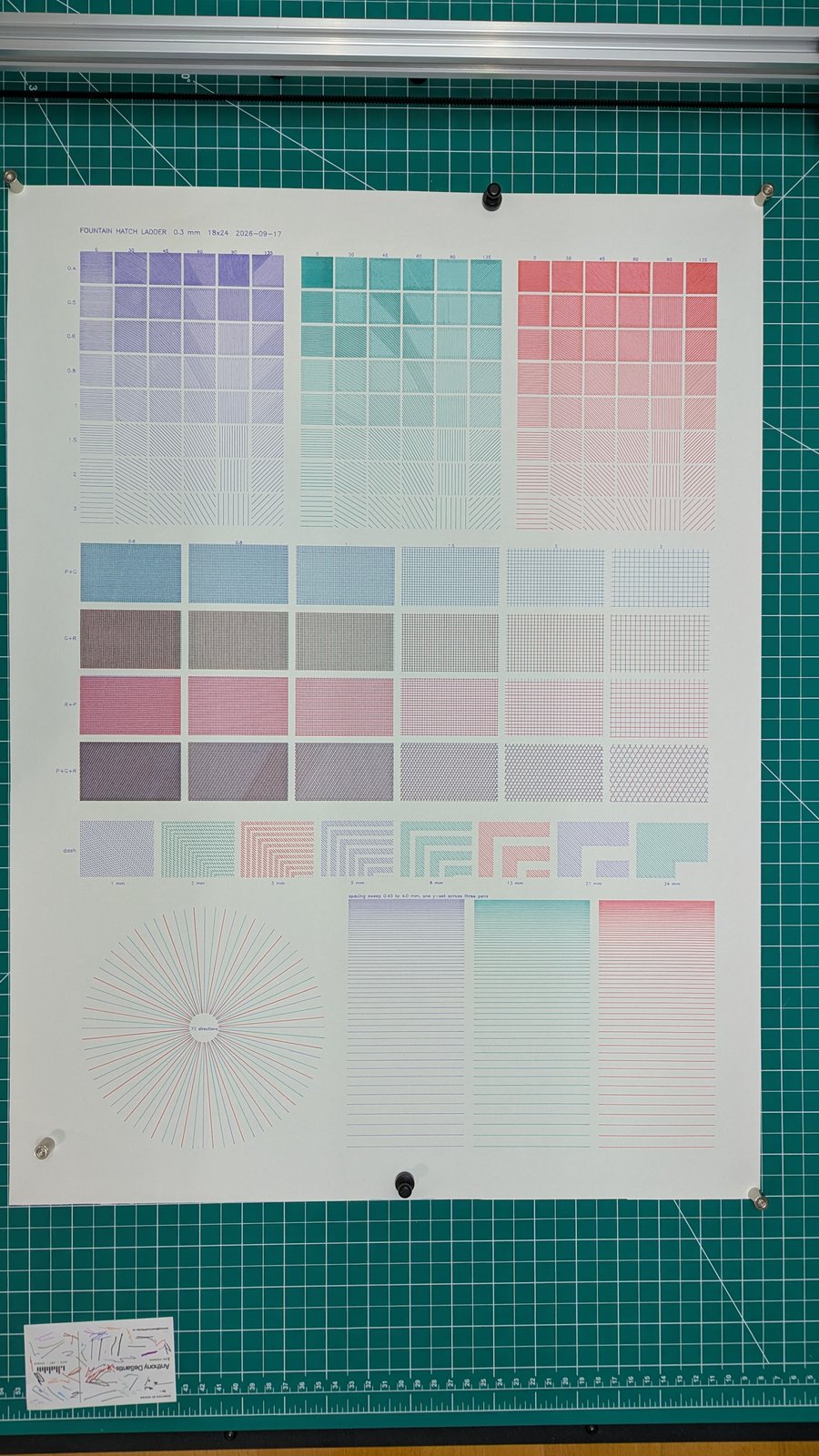
Then I tried to break it. The fountain hatch ladder is an 18 by 24 sheet,
three fountain-pen layers, built as five sub-tests: a hatching ladder of
increasing density at six angles, perpendicular cross-color hatching at
increasing density, a dash and stipple spacing test, a circle filled with
strokes at 5 degree increments across layers, and a spacing sweep from 0.45 to
4 millimeters. This is the plot where a machine with a bulging bed, uneven
belt tension, or sloppy servo control has nowhere to hide. It is the test I
wrote because of the old machine's bed.
The geometry passed. The ladder lines are parallel and evenly stepped at every
angle, the radial fill shows no wobble and no uneven spacing, and there is no
regional fading that would map to a low spot in the bed.
Two findings, and I attribute neither to the machine's motion. First,
the ink density in the single-color ladders is uneven, and the purple, green,
and red cross-hatch at 0.8 millimeters shows the same blotching. The strokes
themselves are perfectly placed. My path optimization (I run vpype over every
plot file) reorders strokes for plot time, so the pen revisits regions at
different ink states, and fountain pens are unforgiving of that. I would still
expect disjoint segments to look more uniform than this, so the pens
themselves carry part of the blame. Second, the ends of long segments plot
slightly darker and thicker than their middles. That is a pen-profile gap:
speed, acceleration, and lift rates tuned to how a fountain pen delivers ink
would close it. I tune profiles when a piece demands it rather than in
advance, and no piece this month demanded it.
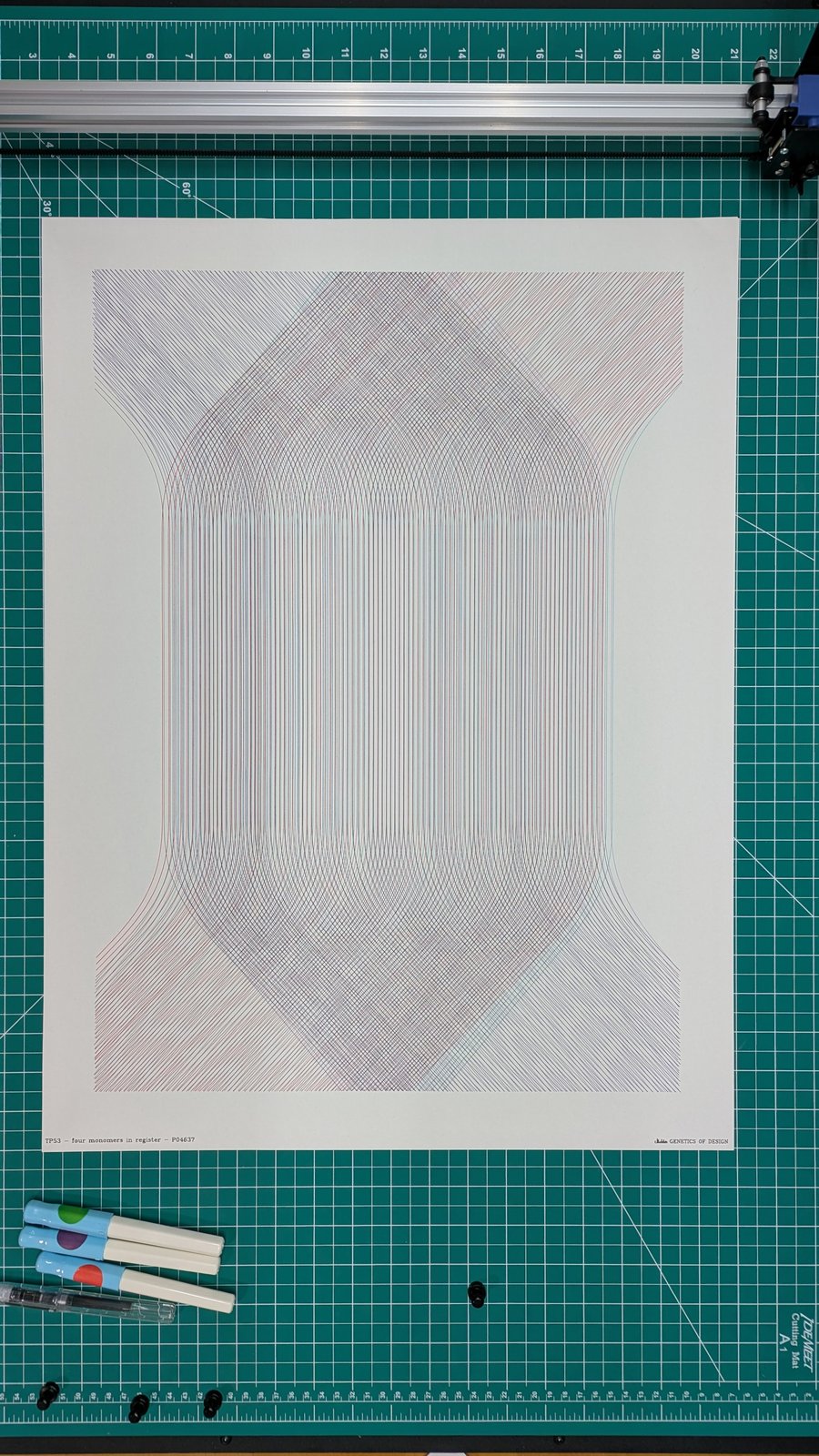
TP53, four monomers in register
The last plot is the reason I wanted this machine, and the start of work I
could not have made at A3. The TP53 gene codes the p53
protein, a tumor suppressor that guards the genome. p53 does not work alone:
it functions as a tetramer, four identical copies assembled into one working
unit.
The piece draws the DNA-binding domain of the canonical p53 sequence (UniProt
P04637, residues 102 to 292) four times on an 18 by 24 sheet: one copy per
monomer, one layer and one fountain pen per copy. A small Python pipeline
pulls the sequence, scores each residue's side-chain polarity on the
Kyte-Doolittle scale, and converts the scores directly into line pitch:
hydrophobic stretches pack the lines tighter, the way they pack in the folded
protein, and polar stretches open them up. The four copies are one family of
curves repeated under the tetramer's own symmetry, mirrored left to right for
the palindromic DNA site it grips and top to bottom for the dimer partner,
with the twin layers tilted a few degrees apart. The pipeline emits the
geometry as layered SVG and the machine does the rest.
One detail connects this piece to the stress test before it. Fountain pens
have an ink floor: below a certain line spacing the hatch closes up into a
wash. The hatch ladder measured that floor at 0.8 millimeters for these nibs,
and the piece is built to respect it, dropping curves out as the weave
tightens rather than ever crossing it. The test sheet calibrated the artwork.
I grew up with Afghan carpets, and their geometry, form built from many
crossing runs of thread, is the visual grammar I wanted for a protein that
only exists as a weave of four strands. Where the four staggered copies cross
in the middle of the sheet, a form assembles that none of the single copies
contains. That is the tetramer, drawn by its own sequence.
This is a first study. The machine held four near-identical dense line fields
in register across just under three hours and two pen changes, and where the
four families cross at the center of the sheet, moire fringes appear that
exist only because the layers are in register. The interference is the
artwork, which makes this about as direct a registration test as I can
design. I will be building this idea into a plotted series on this machine,
and there is an exhibition in the works around it. The plot video is
on Instagram.
Verdict
A month in, the machine has passed every test I designed to catch it out. The
frame stayed square after one initial adjustment, the bed is flat by dial
indicator and by print, reach is honest across all 36 inches, and multi-layer
registration held from a six-layer portrait to four staggered copies of a
protein sequence. The failures I did find, ink-state unevenness and heavy
stroke ends, belong to fountain pens and to my own unfinished pen profiles,
and they would have appeared on any machine.
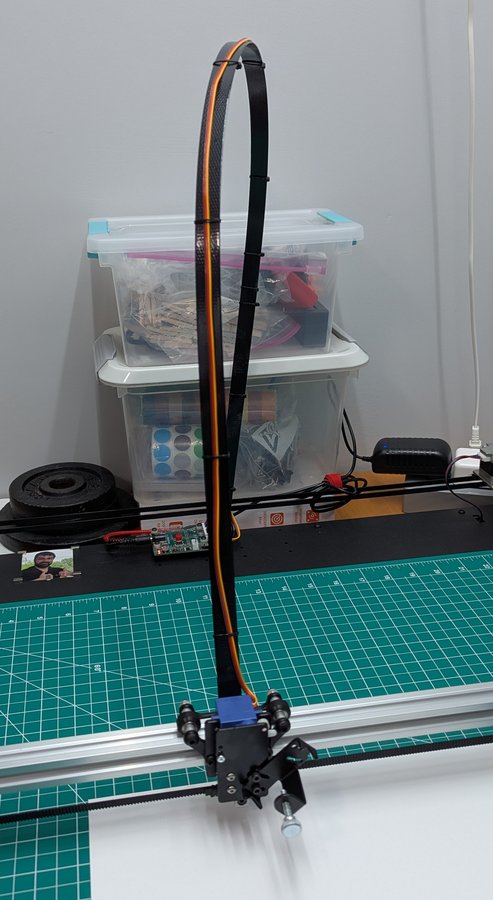
The one design gripe I have is the servo ribbon. The flat cable that feeds
the pen-lift servo stands in a tall arc above the carriage and sweeps the
near side of the machine as it plots, so the 2436 wants about 18 inches of
clearance above the deck and on the operator's side. It has never caught
anything in a month of plotting, but I have kept my desk clearer than usual
out of concern that it could, and on a machine this well behaved that is the
complaint I am left with.
I used the phrase "relaxed speeds" all month, so here are the numbers: my
standard fineliner profile commands about 49 millimeters per second pen down
with acceleration at half scale, against a rated ceiling of 280 millimeters
per second, and the fountain pen profile is gentler still. I run my machines
that way on purpose. Rushing art has cost me more sheets than any hardware
fault ever has, so I have never pushed a plotter toward its limits or toward
some production quota, and I think that respect is a large part of why
plotters have worked out for me. One month is also not enough time to test
the extremes honestly, and this review does not claim to. If I am so
inclined I will check in a year from now with a longer report on the harder
questions, wear and sustained speed among them. What I can say is that at
the pace I actually work, consistency and quality held from the first
squareness check to the last layer of the p53 piece.
The value case, as someone who standardizes hard on plotter, pens, and paper:
the 2436 is the H SE's quality at four and a half times the plotting area,
reached without changing anything else. My workflow is frozen on purpose, and
a new machine usually breaks that freeze: new software stack, new interface,
new parts, new failure modes, and weeks of adjustment before you trust it. The
2436 behaves like a scaled-up iDraw. It speaks the same protocol over the same
wired USB, my existing toolchain drove it on day one, and the only thing I
rebuilt was my pen profiles, which are per-machine work on any plotter. For a
studio that needs a solution that just works, that continuity is worth more
than any single spec.
On price, it sits in a useful gap. Cheaper large-format plotters often ship
without a bed, and fabricating a surface that is flat and coplanar to the
rails is not hard, but it is exactly the kind of variable I standardize to
avoid. The options that do include a bed tend to cost more and plot smaller.
At $2,774 as I write this, with the magnetic steel bed included, the 2436
undercuts both paths.
It also travels better than a 36 inch machine has any right to. At 15
kilograms one person can pack it, and I kept the shipping material because I
take my plotters to exhibits, fairs, and schools to run in public. The H SE
went back into its box with the original cushioning and never lost
calibration; loading the 2436 up works the same way and has been just as
simple. I am pickier about where I bring it, since it needs real table space
on display, but it makes the trip.
That is what has impressed me most about what UUNA TEK has built here. A
studio like mine starts modestly, on a small machine, and standardizes
everything around it: pens, paper, profiles, habits. The 2436 respects all
of that. It asks an artist to change nothing except the size of the paper.
Buy the 2436 if you are upgrading from an iDraw H SE, as I did, because you
want to plot larger and more sophisticated pieces. The simplicity of these
machines is a feature, and it is what makes them maintainable and reliable.